How to Build Your First AI Agent as a Non Technical Founder in 2026
Most content about building AI agents is written by engineers for engineers. It assumes you are comfortable with Python, familiar with API integrations, and ready to spend weeks inside a development environment. If that is not you, most of what gets written about AI agents feels inaccessible and leaves you with more questions than answers.
Here is the truth. You do not need to be a developer to build your first AI agent in 2026. The tools available right now have made it genuinely possible for non-technical founders to go from idea to working agent without writing a single line of code. What you do need is a clear understanding of what you are trying to automate, a structured approach to building it, and a realistic picture of where no-code tools end and where you need engineering help.
This guide gives you all three.
Why Non Technical Founders Are Building AI Agents Right Now
The timing has never been better. The market for no-code AI platforms has grown significantly and that growth happened because people realized they needed tools that actually work for non-technical users. The platforms that exist in 2026 are genuinely powerful. They let you connect your existing tools, describe what you want the agent to do in plain language, and test it through visual interfaces without touching code.
Gartner predicts that 70% of new enterprise applications will use no-code or low-code technologies by 2026.That shift is not happening because no-code is a compromise. It is happening because for a large class of automation problems, no-code is genuinely the right tool.
For founders specifically, the case for building your first AI agent right now is straightforward. The founders who move fast in 2026 are not working longer hours. They are building AI agents that handle the work that does not require human judgment. That is how you scale without scaling headcount.
The question is not whether you should build an AI agent. It is where to start and how to do it without wasting months on the wrong approach.
Step 1: Find the Right Workflow to Automate First
This is the most important decision you will make and it is not a technical decision at all. It is a business decision.
The best first agent is the workflow you already do manually every single day. The one that is slightly boring, completely repetitive, and takes longer than it should. That is the one to build.
Most non-technical founders make the mistake of trying to automate something ambitious on their first attempt. They want to build an AI agent that handles their entire sales pipeline, or one that manages customer onboarding end to end. These are valuable goals but they are the wrong starting point.
Your first agent should have three characteristics. It should be a workflow you do repeatedly, ideally multiple times a day or week. It should have clear inputs and outputs, meaning you know exactly what information goes in and what a good result looks like. And it should be low risk, meaning if the agent gets something wrong, the consequences are minor and easy to correct.
Good first agents for health tech founders include appointment reminder workflows that send personalized messages to patients based on their upcoming schedule. Lead qualification agents that review inbound inquiries and categorize them before they reach your sales team. Documentation drafting agents that take structured inputs from your team and generate first drafts of clinical or operational documents. Meeting summary agents that take notes from recorded calls and produce structured action items.
Start with one. Make it work reliably. Then build the next one.
Step 2: Understand What Your Agent Actually Needs to Do
Before you open any tool or platform, you need to map out your workflow in plain language. This step takes thirty minutes and will save you weeks of confusion later.
Write down the answers to these four questions about the workflow you have chosen.
What starts the process? This is your trigger. It might be a form submission, an incoming email, a new entry in a spreadsheet, a scheduled time, or a patient booking a slot in your calendar. Every agent needs a clear trigger that tells it when to start working.
What information does the agent need to do its job? List every piece of data the agent will need access to. For a patient reminder workflow, that might be the patient name, appointment time, provider name, and contact details. For a lead qualification agent, it might be the company size, use case description, and budget range from an intake form.
What does the agent actually do with that information? This is the action sequence. Write it out step by step as if you were describing it to a new team member. Send an email. Update a record. Generate a document. Create a task. Each step in your sequence becomes a node in your agent workflow.
When should a human get involved? This is your escalation rule. Every well-designed agent has a clear boundary where it stops and asks for human input. Define that boundary before you build, not after your agent does something unexpected with a real user.
With those four questions answered, you have everything you need to start building.
Step 3: Choose the Right Tools for Where You Are Right Now
A practical early stack for a non-technical founder in 2026 starts with an AI reasoning layer, which usually means accessing foundation models through APIs via a simple integration layer, and an automation and workflow layer, where tools like Make.com or n8n let non-technical founders build sophisticated multi-step workflows without code.
In plain terms, here is how to think about your tool choices.
No-code platforms are where most non-technical founders should start. Tools like n8n, Make.com, Dify, and Lindy let you build agent workflows using visual drag and drop interfaces. You connect your tools, define your trigger, map out your action sequence, and add AI reasoning where you need the agent to make judgments rather than just follow rules. Building an agent takes 15 to 60 minutes on most no-code platforms today. Business users, not just engineers, are creating agents.
AI reasoning via API is the layer that gives your agent its intelligence. In 2026, this means connecting to foundation models from providers like Anthropic or OpenAI through your no-code platform. You do not need to train your own model or understand the technical details of how these systems work. You write a clear prompt that tells the model what you want it to do with the information it receives, and the platform handles the connection.
Your existing tools are what your agent will connect to and act on. Most no-code platforms have pre-built connectors for the tools that startups commonly use. Your CRM, your calendar, your email platform, your EHR if you are in health tech, your Slack workspace. The agent sits in the middle and coordinates actions across these systems based on the workflow you have defined.
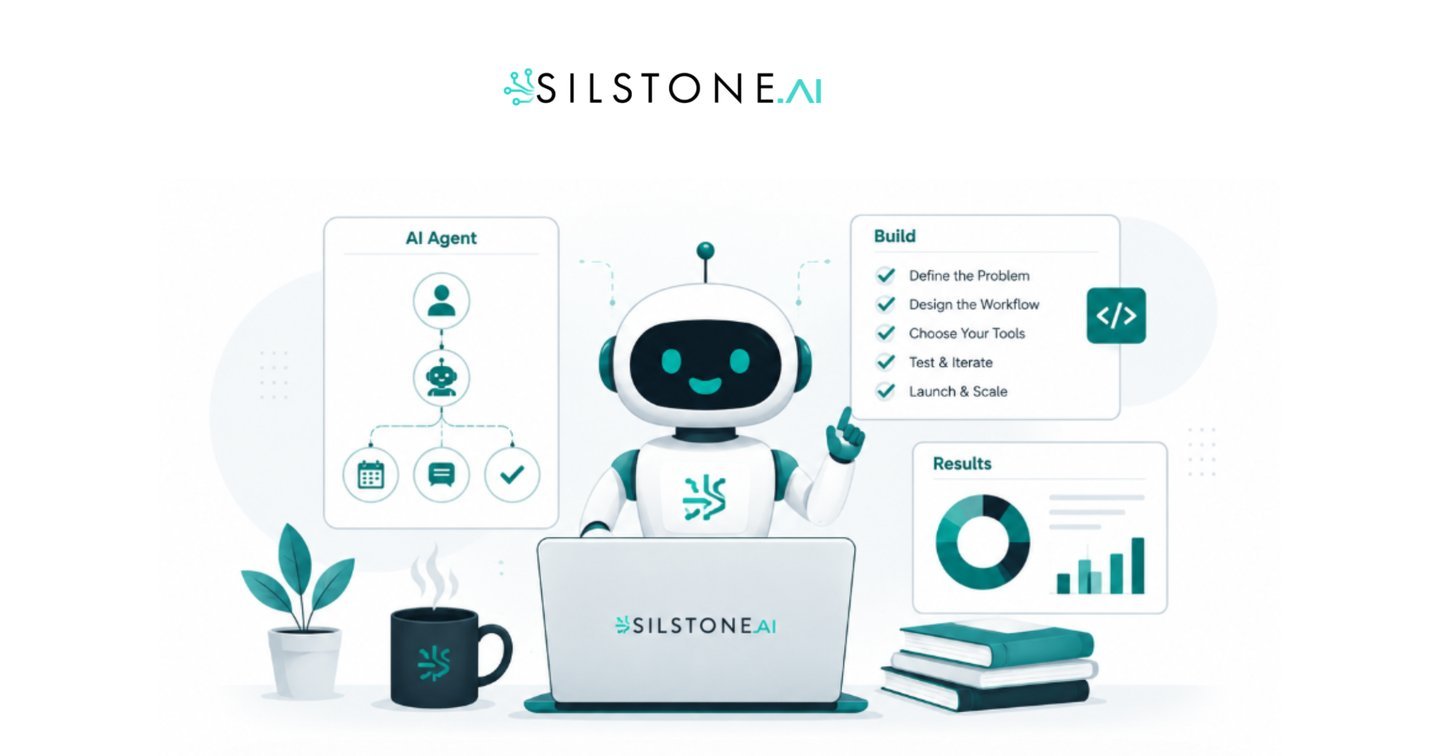
Even simple agents benefit from clear architecture. The pattern that works is a trigger layer that starts the agent, a processing layer where AI reasoning happens, and an action layer where the agent executes tasks across connected systems.
Step 4: Build It in an Afternoon, Not a Quarter
One of the most common mistakes non-technical founders make when building their first AI agent is treating it like a software development project with a long planning phase, detailed specifications, and a formal launch date.
Your first agent should be built in an afternoon and tested with real inputs the same day.
Pick your no-code platform. Most of them have free tiers that are more than sufficient for a first agent. Connect your trigger. Map your action sequence. Write your AI prompt. Run a test with real data from your own workflow. See what breaks. Fix it. Run another test.
The easiest wins usually come from founder workflows, solo-operator workflows, or small-team operational pain points where the process is known and the cost of delay is obvious. Start with one low-risk system, then add review gates and expand only after you can measure the result.
The goal of your first agent is not perfection. It is a working system that handles the happy path reliably and escalates to you when it encounters something unexpected. You will improve it over time as you understand where it performs well and where it needs human support.
Step 5: Know When You Need Engineering Help
No-code tools are genuinely powerful and genuinely limited. Understanding where those limits are will save you from spending weeks trying to force a no-code platform to do something it was not designed to handle.
The right time to bring in engineering support is when your workflow involves regulated data that requires specific security and compliance architecture. In health tech, the moment your agent touches patient data, you are in HIPAA territory in the US and PHIPA territory in Canada. No-code platforms are not built to meet those compliance requirements out of the box. Building a compliant agent for a healthcare environment requires engineering depth that goes well beyond what visual workflow tools can provide.
You also need engineering support when you are ready to scale your agent from handling tens of requests to handling thousands. The architecture that works for a small-volume no-code workflow is not the same architecture that handles enterprise-grade load reliably. And when your agent needs deep integrations with complex systems like EHRs, diagnostic platforms, or proprietary clinical databases, the pre-built connectors in no-code tools will not be sufficient.
You do not need to be an AI researcher or ML engineer to build a successful AI agent startup. Most successful founders have domain expertise in the industry they are serving rather than deep AI expertise. You can hire or partner with AI engineers for the technical implementation while you focus on customer development, product strategy, and go-to-market execution.
The division of responsibility that works best for non-technical founders is clear. You own the problem definition, the workflow design, and the business logic. Your engineering team owns the technical implementation, the compliance architecture, and the production infrastructure. Your first no-code agent is the proof of concept that shows your engineering team exactly what you are trying to build and why it is worth building properly.
Step 6: Measure What Your Agent Is Actually Doing
An AI agent you cannot measure is an AI agent you cannot improve. Before you hand off any workflow to an agent, define the metric you will use to evaluate whether it is working.
For a patient reminder agent, that might be the percentage of reminders sent successfully and the reduction in no-show rates compared to your manual process. For a lead qualification agent, it might be the time saved per lead and the accuracy of the categorizations compared to what a human would have decided. For a documentation agent, it might be the percentage of drafts that are accepted without significant revision.
Check these metrics weekly for the first month. You will almost certainly find edge cases your agent handles poorly. Some of those will be fixable with a better prompt or a refined workflow. Others will tell you something important about the limits of what this particular automation can do reliably.
The agents that deliver lasting value are the ones that get measured, refined, and improved continuously. The ones that get set up and forgotten tend to drift in quality over time as the inputs they receive change and the edge cases accumulate.
What Comes After Your First Agent
Building your first AI agent is not the end goal. It is the beginning of understanding what is possible and what is worth investing in engineering resources to build properly.
Most non-technical founders who build their first no-code agent reach the same realization within a few months. They can see the full opportunity clearly, they know exactly which workflows would benefit from proper AI agent infrastructure, and they understand enough about how agents work to have productive conversations with engineering teams about what it would take to build them right.
That transition from no-code prototype to production-grade system is where the real competitive advantage gets built. And it is where having the right engineering partner makes an enormous difference in how fast you can move and how well the result holds up in a real operational environment.
Silstone Group works with founders at exactly this stage, helping teams move from working prototypes to production-ready AI agent infrastructure that is built for compliance, scale, and the specific demands of the healthcare environment.
Visit silstone.ai to learn more or book a discovery call.